

For Parents, For Mamas, For the child who is silent and wants to say the word
There Are 4 Kinds of Late Talkers, and the Advice That Helps One Can Quietly Stall Another.
On this page, you will discover:
- Which of the four developmental tiers your child occupies through a ten-minute baseline check completed tonight at home, without appointments, waitlists, or guesswork.
- The specific interaction protocols calibrated to your child's stage, allowing fifteen minutes of existing daily routine to generate measurable progress rather than friction.
- Why generic advice failed to produce results, and why stalled progress indicates an uncalibrated target rather than a lack of caregiver effort.
- Objective, visible progress: a refrigerator Word Wall documenting your child's emerging vocabulary in real time, dated as each word occurs.
- Clinical intake preparation: thirty days of documented home observation data to hand a speech therapist instead of subjective recollection.
Picture Two Mothers. Two Toddlers. The Same Article.
Two mothers read the exact same article for two-and-a-half-year-olds who aren't talking.
The advice is standard: narrate your day, read more books, ask questions.
The first mother follows it for three weeks, and her son begins imitating new words.
The second mother follows it just as strictly. She narrates every meal, holds up flashcards, and reads through three picture books every evening. Her son turns his head away from the page and stays silent.
Same advice, identical effort, opposite results.
The standard explanation for that gap is usually: every child is different, just wait and see. It sounds patient, but it offers no actionable direction.
The actual reason is simpler: those two toddlers were not dealing with the same challenge.
The first boy already possessed a foundation of single words and needed guidance combining them.
The second boy was still struggling to shape raw vowel sounds and had no stable words to combine yet.
The advice worked for the first child because the article was written specifically for his stage. It failed the second child because it demanded a step he was not equipped to take.
"Late talker" is not a single diagnosis. It is four distinct developmental stages.
The techniques that move a child forward at one stage will stall a child at another.
Before you change how you spend your evenings, there is only one relevant question:
Which of the four stages is your child in right now?
You can determine that starting point tonight.
It takes ten minutes at your kitchen table with a single-page checklist: The Communication Snapshot.
This assessment identifies your child's specific communication zone.
Once you have that baseline, the trial-and-error ends. You stop rotating through generic parenting advice and begin applying the interaction protocols calibrated for his exact developmental threshold.
Instead of trying to manufacture extra hours in your day, you direct the fifteen minutes you already spend at meals, bath time, and bedtime toward moves that produce measurable responses.
Here is what that progression looks like in practice.
Consider a Tuesday evening three weeks from now.
It is bath time. Instead of filling twenty minutes of silence with continuous, unreturned narration, you use a single routine built for your child's exact zone.
You set down the washcloth. You pause. You give him five full seconds of uninterrupted quiet.
Your child leans over the edge of the tub and fills that space with an intentional sound.
You recognize the attempt immediately because you know the exact milestone his stage demands.
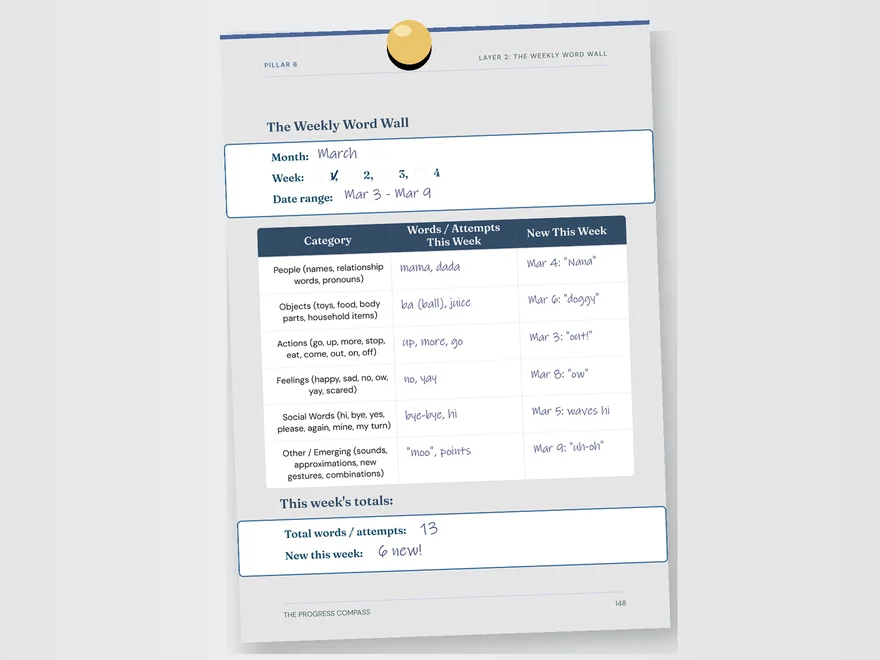
On the kitchen refrigerator hangs a sheet of paper with twenty ruled lines. Three weeks ago, it was blank.
Tonight, seven rows are filled in your handwriting with single words and the exact calendar dates they occurred.
When a relative or neighbor asks whether he is talking yet, you no longer offer an apologetic shrug.
You give them a clear, factual answer: "He is in the Yellow Zone, he gained four functional words this month, and this week we are practicing two-word combinations."
If you are currently waiting on a clinical evaluation, the dynamic changes entirely.
You do not walk into that appointment with vague recollections of his silence.
You hand the speech-language pathologist thirty days of dated, structured observations.
The idle months on a waitlist become usable clinical data.
This framework is not a substitute for a licensed speech-language pathologist. If your child requires a formal clinical evaluation, schedule one.
This system addresses the interim: the eight to sixteen weeks families typically spend sitting on intake waitlists without a structured protocol for home intervention.
The strategies within this kit are not speculative theories. They are drawn directly from established clinical methodologies, parent-implemented language intervention, timed pause-and-wait protocols, and systematic linguistic expansion.
The difference is structural. Clinical techniques usually arrive as an undifferentiated list of recommendations that parents are left to test through trial and error. Early Words Studio categorized these protocols into four sequential developmental tiers.
You identify your child's tier. You apply only the interventions calibrated to that baseline.
This framework is the Zone-Match Method.
The four Zone-Match tiers
Red Zone
Yellow Zone
Green Zone
Blue Zone
"Late talker" is not a uniform diagnosis
It describes four distinct developmental baselines that require fundamentally different intervention strategies.
A toddler who produces isolated vocalizations without stable words is navigating a completely different linguistic hurdle than a child with a thirty-word vocabulary who cannot combine them.
Giving both children the same generalized advice sheet makes no more sense than handing the same lesson plan to a beginner and an intermediate student.
This distinction is grounded in clinical research.
In a seminal meta-analysis published in the American Journal of Speech-Language Pathology, Vanderbilt University researchers Roberts and Kaiser reviewed the literature on parent-implemented language intervention.
Their conclusion was definitive: toddlers whose parents were trained in targeted, stage-specific language strategies at home made significant, measurable gains.
Success did not require clinical credentials or hours of added drills.
The determining factor was strategy alignment, applying the precise technique required for the child's current stage.
When you identify your child's baseline, you eliminate the fatigue of rotating through disconnected internet tips.
Instead of testing five random techniques in the hope that one works, you apply the small set of protocols engineered for your child's exact developmental threshold.
This raises a necessary question: if early speech development consists of four distinct starting points, what has generic advice actually been targeting?
The answer is that most standard recommendations, narrate your day, read more books, ask open-ended questions, are written for a statistical average.
In early language development, a statistical average does not exist.
Public advice is engineered for broad distribution, which forces it to target the middle of the developmental bell curve.
When those generalized techniques fail to produce words at home, the guidance is not necessarily incorrect. It is simply calibrated for a child at a different developmental milestone.
This explains why two families can execute the exact same instructions and see completely divergent outcomes.
The difference is not effort, diligence, or luck. It is developmental alignment.
You do not need an expanding archive of bookmarked articles and conflicting tips.
You need a single, targeted protocol built for the specific stage your child occupies today.
Persistent effort yields zero progress when the technique is aimed above or below a child's developmental baseline.
Consider the common practice of direct quizzing: pointing to an object and demanding, "What's this? Can you say dog?"
It feels like active teaching. For a child who has not yet established stable imitation, it introduces cognitive pressure rather than language acquisition.
The instinct is understandable; the intervention is simply mismatched.
This structural mismatch explains the specific exhaustion of following standard advice daily while seeing no measurable change.
It is not a failure of diligence. It is un-leveraged effort directed at the wrong target.
When the strategy aligns with the child's actual stage, existing routines do the heavy lifting.
The fifteen minutes already spent at meals, in the car, or during bath time begin generating functional responses.
This also explains why "wait and see" became the default recommendation.
Without a reliable method to evaluate whether an intervention is working, inaction feels safer than risking an error.
Parents default to watching the calendar, searching symptoms late at night, and second-guessing their instincts.
That hesitation is not indifference; it is the natural consequence of lacking an objective starting point.
When the fundamental failure mode is strategic mismatch, increasing volume will not resolve it.
You cannot overcome an incorrect target through repetition.
The correction is calibration.
This is the core architecture of the Zone-Match Method.
The system identifies your child's baseline, their specific communication zone, and assigns only the language models designed for that developmental threshold.
This approach does not require additional hours in your schedule, artificial drills, or specialized equipment.
It redirects the daily interactions you are already having so your effort lands where your child can process it.
The immediate question is practical: how do you determine your child's communication zone?
Ten minutes to your child's zone
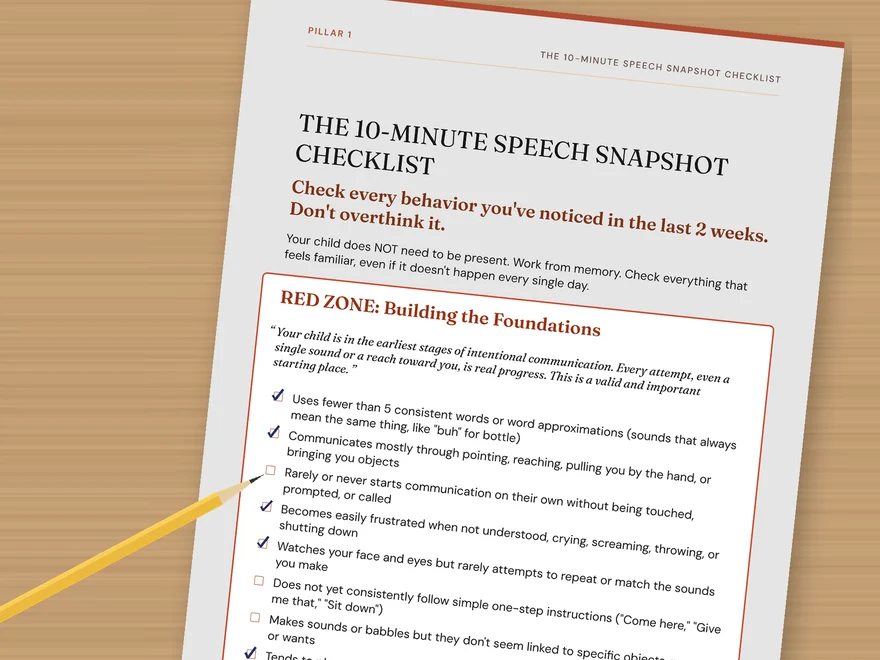
The baseline assessment takes approximately ten minutes using the Communication Snapshot, a single-page behavioral checklist.
Rather than evaluating your child against generalized age charts, the Snapshot tracks observable communication patterns across four diagnostic criteria:
Vocal repertoire: Isolated sounds, babbling, and consonant formation.
Word inventory: The presence, stability, and consistency of single words.
Linguistic structure: Whether words remain isolated or are combined into functional phrases.
Non-verbal intent: How gestures, eye contact, and physical cues are used to signal needs.
The assessment categorizes your child into one of four developmental tiers: Red, Yellow, Green, or Blue.
Because this baseline is determined by actual functional behavior rather than chronological age, it establishes an objective operational starting point.
Identifying your child's zone, however, is only the diagnostic half of the system.
The real leverage comes from the interaction protocols calibrated for that specific tier.
Once you identify your child's zone, the system provides a targeted set of interaction protocols rather than an unorganized collection of tips.
Each developmental tier focuses on specific clinical interaction models:
Calibrated Pause-and-Wait: Structuring intentional, five-to-ten-second silences that give your child the processing time needed to initiate or return a vocalization.
Linguistic Expansion: Systematically building upon whatever single sound or word your child produces, modeling the immediate next developmental step without correction.
Forced-Choice Structuring: Offering clear, low-pressure visual or verbal options to encourage vocal intent while eliminating the anxiety of open-ended demands.
These protocols adapt methods used daily by speech-language pathologists into direct, home-based routines.
You do not need to set aside dedicated "therapy time" or purchase specialized materials.
The framework embeds these techniques directly into existing daily patterns, during meals, in the car, or while getting dressed.
The remaining operational consideration is measurement: how do you track whether these daily adjustments are producing verifiable progress?
Progress in early language acquisition is often subtle and easily lost in the rush of daily routine.
The system captures these incremental shifts through structured tracking, recording emerging consonant sounds, non-verbal communicative gestures, and new single words as they occur.
Instead of relying on subjective memory to evaluate whether your child is improving, you maintain an objective record.
A dated Word Wall turns isolated daily interactions into a tangible, chronological log of developmental progress.
For families currently waiting on a clinical evaluation, this log serves an immediate diagnostic purpose.
When your appointment date arrives, you do not present the speech-language pathologist with vague recollections or anxious impressions.
You hand them thirty to sixty days of documented home observation data.
The waiting period ceases to be lost time; it becomes an active developmental baseline.
Two Operational Approaches
At this junction, you have two approaches.
The first is to continue collecting generalized advice, testing disconnected tips calibrated for an average child while the developmental calendar moves forward.
The second is to establish your child's exact baseline tonight in ten minutes, eliminating mismatched interventions and executing the targeted protocols designed for his specific stage.
That structured framework is the foundation of The Late Talker Kit.
Immediate digital access · Single one-time payment · 30-day unconditional guarantee
A glimpse of what you'll have in your hands tonight
Inside the Kit, you will find direct-application protocols including:
- The 10-Minute Intake Assessment: How to identify which of the four developmental tiers your child occupies tonight, without guessing his baseline or navigating a waitlist.
- The Pressure-Free Verbal Swap: Why the common instinct to point and demand "Say dog" triggers cognitive shutdown in pre-verbal toddlers, and the three-word adjustment that invites spontaneous vocal imitation instead.
- The Calibrated Latency Protocol: Why most parents unintentionally abort speech attempts by speaking at the three-second mark, and the exact window of uninterrupted silence required for neural processing.
- Pre-Verbal De-escalation: How to resolve point-and-scream frustration cycles this week using a structured visual Choice Board, giving your child a reliable communication outlet before vocal words develop.
- The Joint-Attention Pivot: The single sentence formula to deploy when your child hands you an object, replacing the reflexive praise that inadvertently closes the language window.
- The 6-Routine Integration Map: How to convert ordinary friction points (car rides, mealtime, bath routines) into high-frequency speech opportunities that outperform isolated flashcard drills.
- The Caregiver Alignment Brief: How to standardize language habits across over-quizzing relatives, fast-talking daycare staff, and well-meaning partners without interpersonal friction.
- The Red-Flag Differential: Clear, non-alarmist criteria that distinguish typical developmental latency from clinical indicators requiring immediate professional evaluation.
- Three Silent Progress Indicators: The non-verbal milestones (gaze shifts, phonemic approximations, intentional gesture pairing) that confirm language acquisition is occurring even before words emerge.
- The 30-Day Intake Portfolio: How to compile dated home observation data that transforms an uncertain initial evaluation into an actionable clinical strategy session.
- Every protocol is calibrated to your child's specific developmental zone. None require specialized equipment, extra schedule blocks, or flashcard drills.
Introducing The Late Talker Kit
The Late Talker Kit is a printable home intervention system built around the Zone-Match Method for parents of pre-verbal and speech-delayed toddlers.
It is not a theoretical video course or a multi-week training seminar.
It is a modular toolkit designed for immediate implementation:
Assess: Complete the single-page baseline checklist to identify your child's communication zone.
Select: Print the specific visual tools, scripts, and routine maps calibrated for that tier.
Implement: Integrate the targeted interaction models into your existing daily routines tonight.
The complete six-pillar architecture is detailed below.
The Six Pillars
Pillar 1: The Communication Snapshot
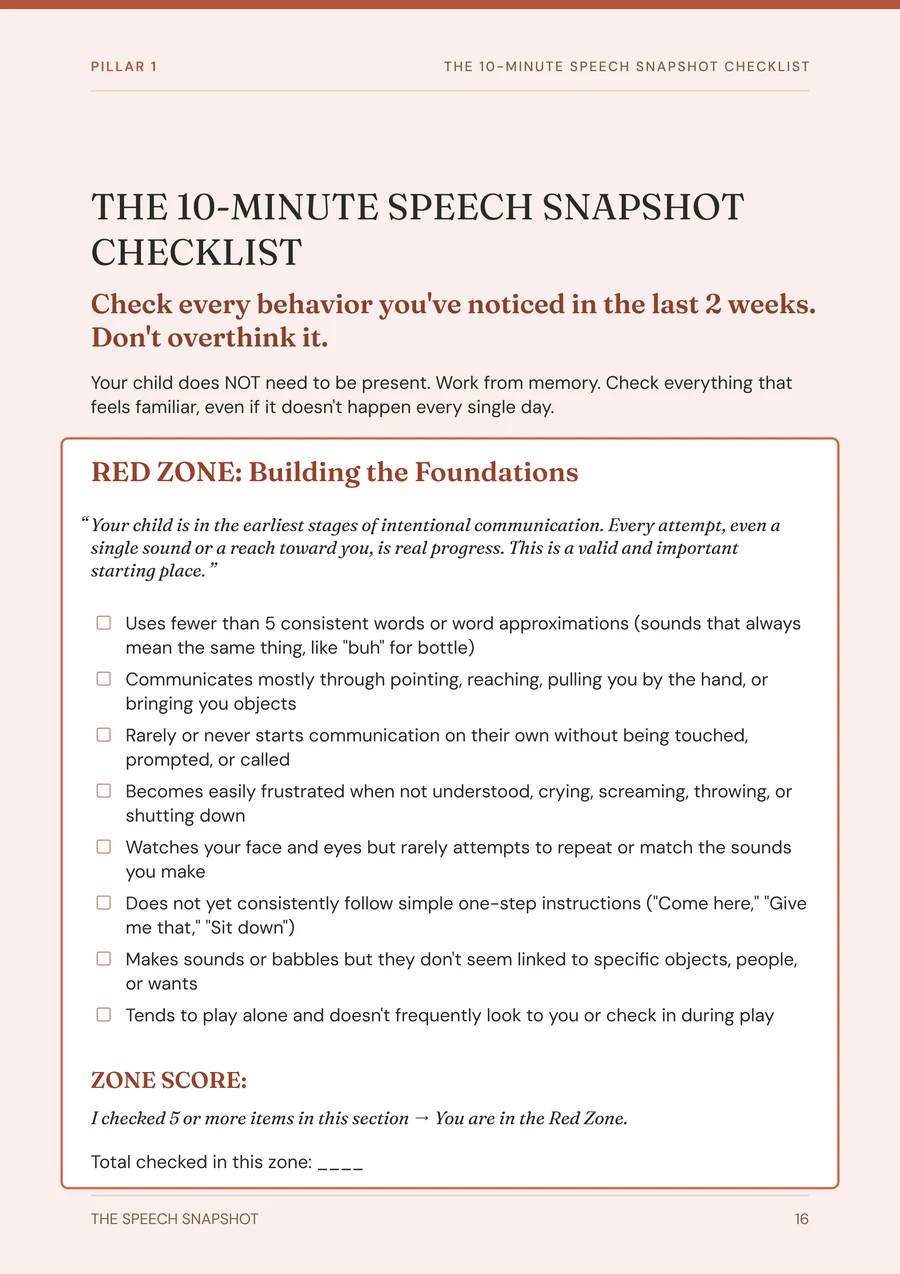
A single-page diagnostic checklist that evaluates your child's functional communication patterns in approximately ten minutes.
Identifies current expressive behaviors across vocal sound production, gesture use, and emerging words.
Maps your child into one of four distinct developmental tiers: Red, Yellow, Green, or Blue.
Establishes an immediate priority path, eliminating trial-and-error and defining which interventions apply today.
This assessment establishes the objective baseline required to select only the tools calibrated to your child's stage.
The Communication Snapshot — the single-page checklist.

Pillar 2: The Communication Bridge
A structured visual communication toolkit designed to establish functional intent and de-escalate frustration before spoken words emerge.
Includes four core physical instruments: High-contrast printable picture cards, a structured Choice Board, Two-Choice prompt scripts, and a basic emotion-identification strip.
Closes the pre-verbal expression gap: Provides an immediate non-verbal channel for your child to signal specific wants and needs, ending point-and-scream cycles.
Reduces daily behavioral friction: Stabilizes high-stress interaction points—such as meal selections and activity transitions—while expressive speech is developing.
Picture cards and the Choice Board, ready to cut out.
Pillar 3: The 15-Minute Play Formula
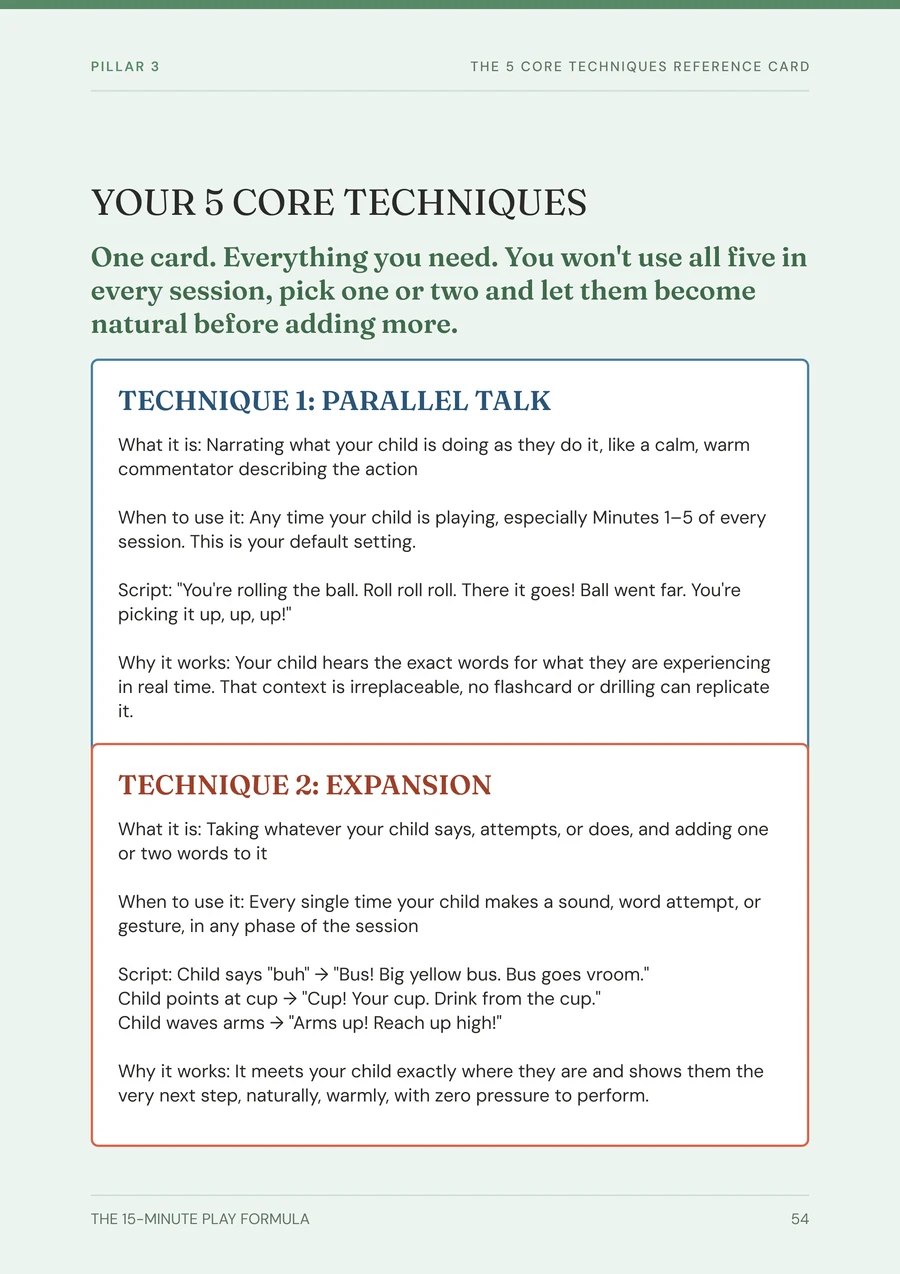
A structured, three-phase floor-play protocol that translates clinical speech techniques into fifteen-minute daily interaction blocks.
Three-phase session architecture: Organizes floor time into clear setup, targeted stimulation, and low-pressure closing phases.
Five clinical interaction models: Integrates core speech-language techniques—including joint attention, parallel talk, and calibrated modeling—matched to developmental tiers.
16 zone-sorted activity cards: Printable floor guides that specify exact engagement prompts using ordinary household toys, requiring zero specialized equipment.
This protocol replaces aimless floor time with a repeatable, time-boxed routine engineered for your child's exact baseline.
The 16 activity cards, sorted by zone.
Pillar 4: The Routine Language Map
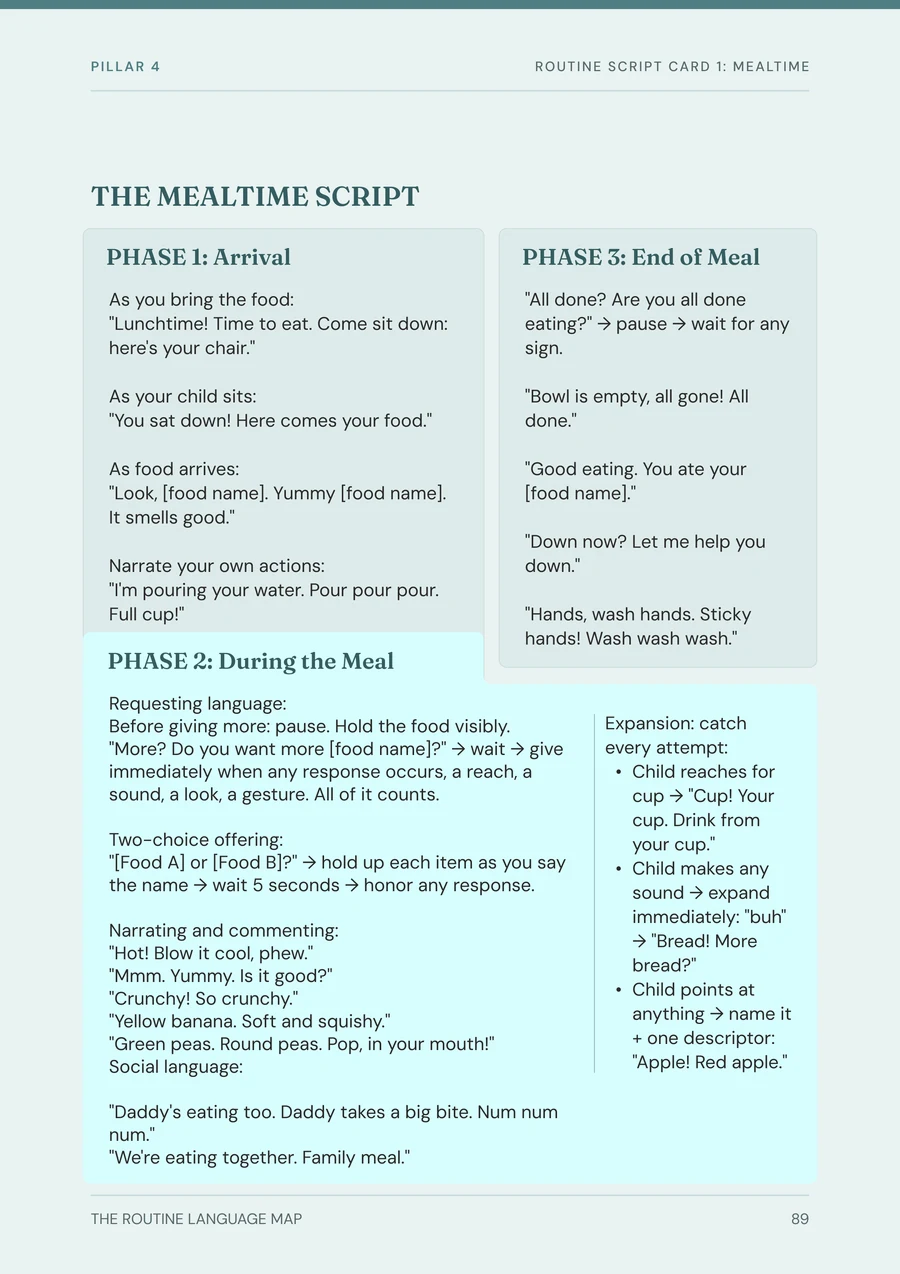
A structured integration guide designed to embed language-stimulation protocols directly into everyday household routines without adding dedicated practice blocks.
Six routine prompt cards: Direct interaction scripts and positioning cues calibrated for high-contact daily moments—including meals, bathing, vehicle transit, and dressing.
The Caregiver Consistency Card: A single-page reference guide that aligns verbal prompts, pacing, and response latency across parents, babysitters, and extended family.
Zero-schedule intervention: Eliminates the demand for extra therapy hours by turning unavoidable daily tasks into functional communication opportunities.
Routine prompt cards and the Caregiver Consistency Card.
Pillar 5: The Script Vault
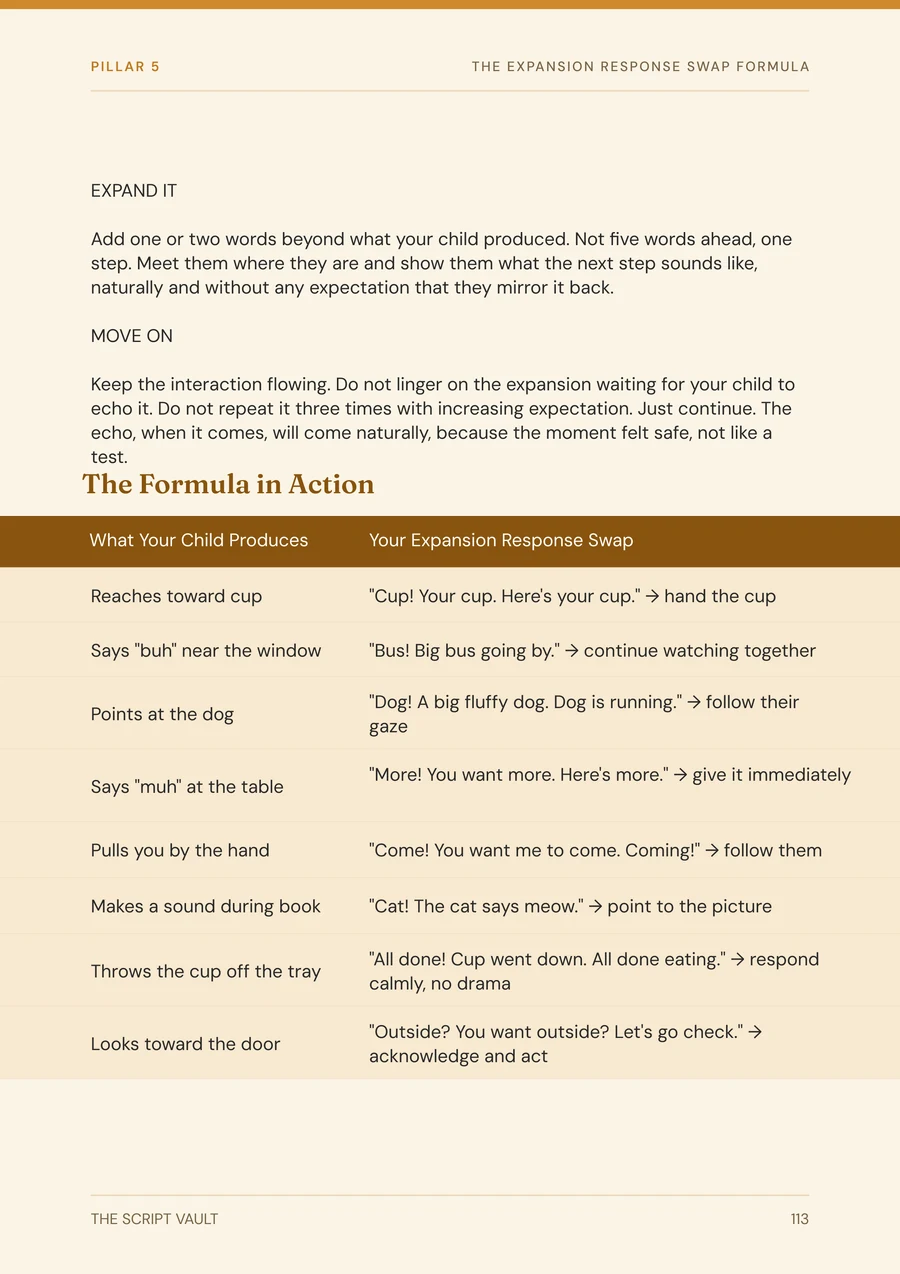
A reference library of verbal expansion formulas and interaction scripts designed to provide immediate phrasing models during real-time interaction.
The Expansion Response Swap: A standardized verbal protocol that models the next developmental language step without issuing corrections or quiz demands.
Five situational script categories: Ready-to-use verbal models calibrated for shared book reading, toy interactions, physical play, routine requests, and joint-attention moments.
Real-time execution cues: Eliminates conversational hesitation by giving caregivers exact verbal templates matched to whatever sound or word the child produces in the moment.
Script Vault: verbal models for each situation.
Pillar 6: The Progress Compass
A documentation and milestone-tracking system engineered to record developmental markers and compile clinical intake data.
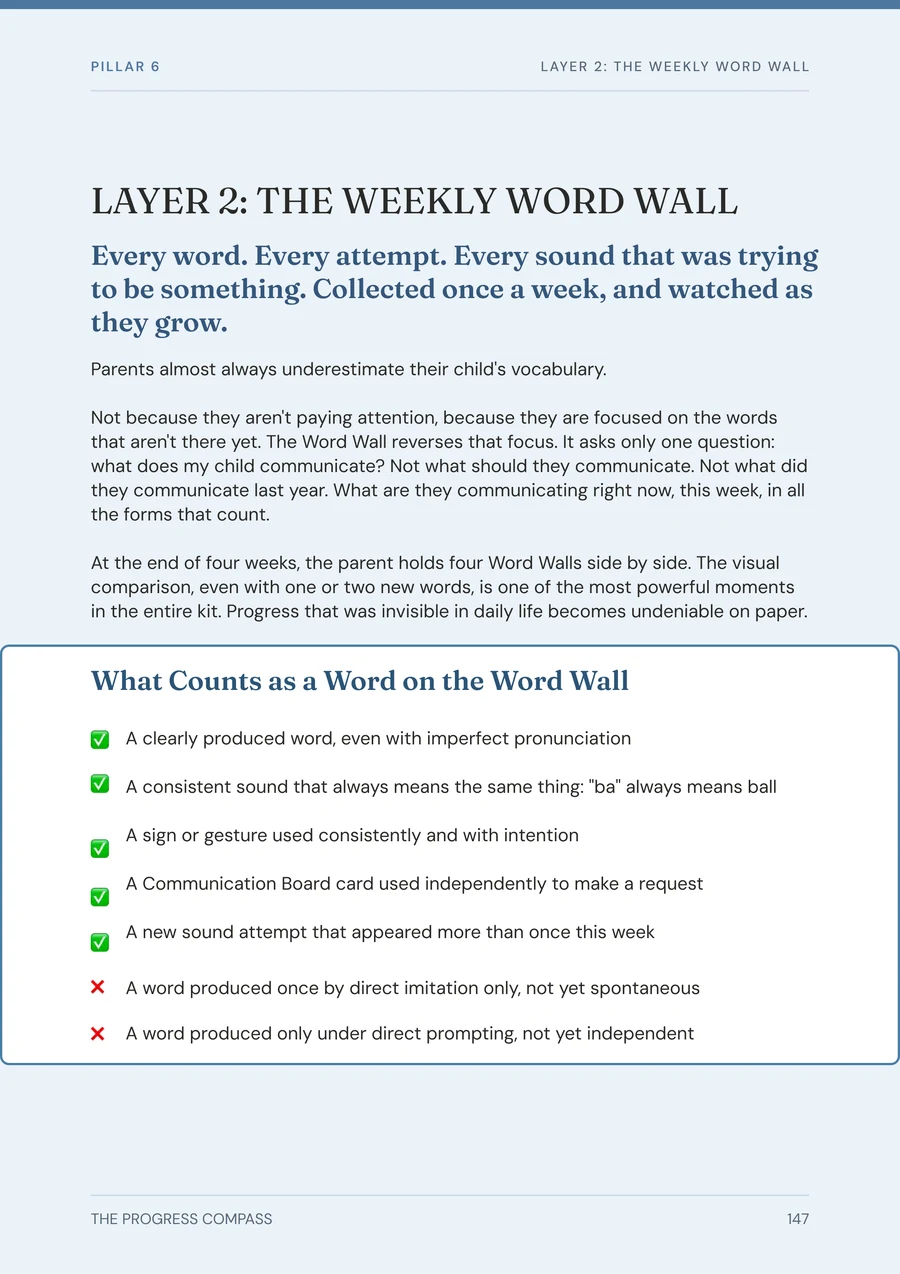
Four-part tracking suite: Includes a printable Daily Log, a refrigerator Word Wall, a Monthly Baseline Snapshot, and the structured 30-Day Progress Portfolio.
Objective milestone capture: Systematically logs phonemic attempts, single-word emergence, and gesture frequency, converting subtle developmental shifts into verifiable data.
Clinical intake documentation: Compiles thirty days of structured home observation data to present to speech-language pathologists, replacing subjective recollection with dated evidence.
Daily Log, Word Wall and the 30-Day Progress Portfolio.
Plus three bonuses
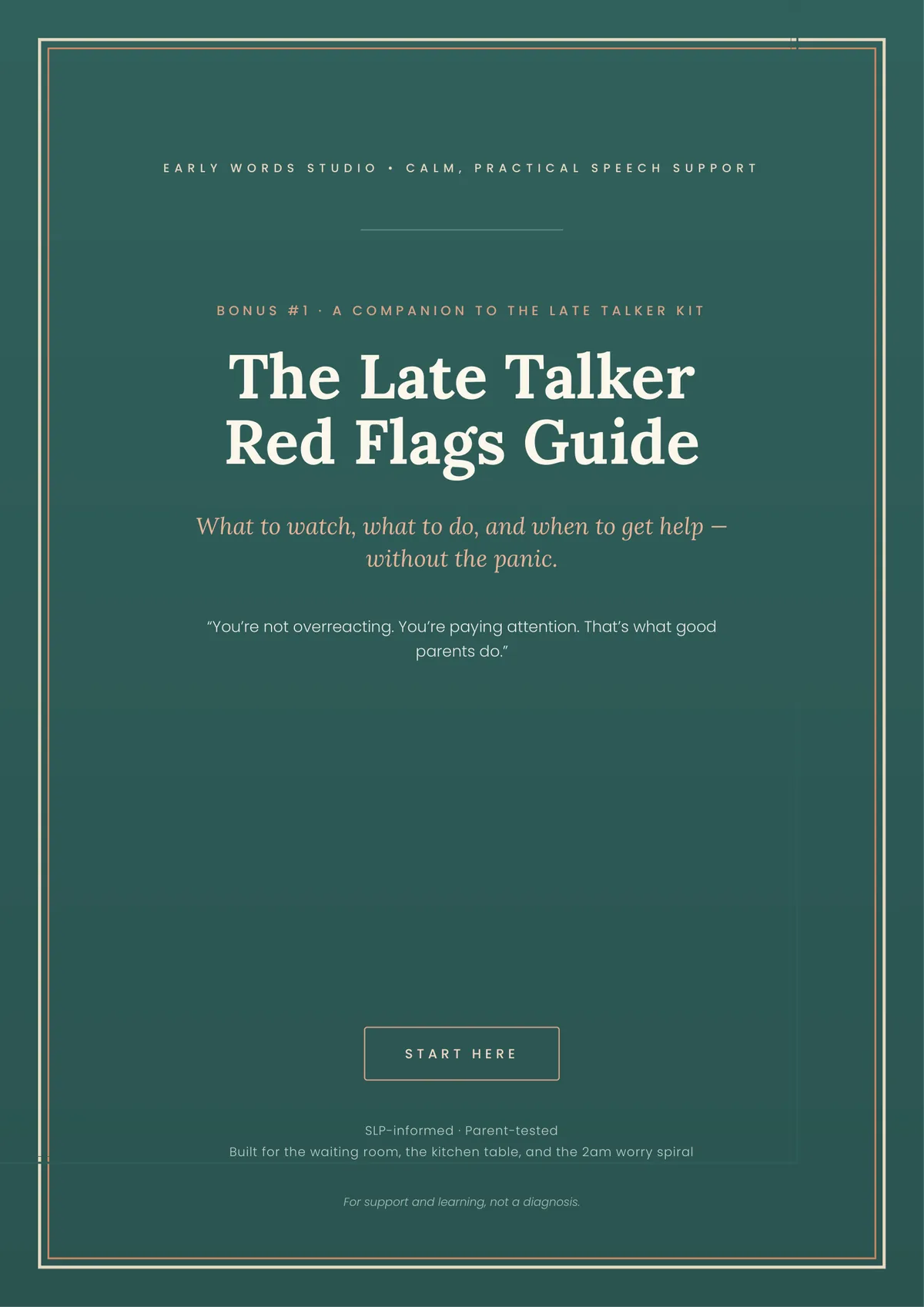
Bonus 1: The Red Flags Guide ($27 Value)
A non-alarmist clinical differential guide designed to distinguish typical expressive delay from indicators requiring immediate professional evaluation.
Differential milestone criteria: Outlines the specific developmental markers that warrant a formal clinical referral versus those consistent with isolated expressive language delay.
Objective observation criteria: Evaluates non-verbal social reciprocity, receptive language comprehension, and hearing responsiveness to prevent misinterpretation of developmental patterns.
Structured referral thresholds: Establishes clear, objective benchmarks for when to seek an evaluation, eliminating open-ended internet symptom searches.

Bonus 2: The Caregiver Briefing Pack ($27 Value)
A set of single-page caregiver alignment sheets engineered to standardize language-stimulation practices across family members, childcare providers, and secondary caregivers.
Standardizes household interaction protocols: Aligns verbal pacing, latency pauses, and response models across partners, grandparents, and babysitters without interpersonal friction.
Eliminates counterproductive speech habits: Replaces rapid-fire questioning and talking over pre-verbal attempts with structured wait times and low-pressure modeling.
Modular, single-sheet handoffs: Provides concise, non-technical briefing summaries designed to be handed directly to daycare staff and relatives.

Bonus 3: The First Words Milestone Map ($19 Value)
A developmental sequence map that outlines the precise progression of early language acquisition, identifying your child's current threshold, the immediate next milestone, and what functional progress looks like in practice.
An objective clinical standard that eliminates arbitrary comparisons against age-bracket generalizations and peer milestones.
And if you join during the founding window, one more thing:
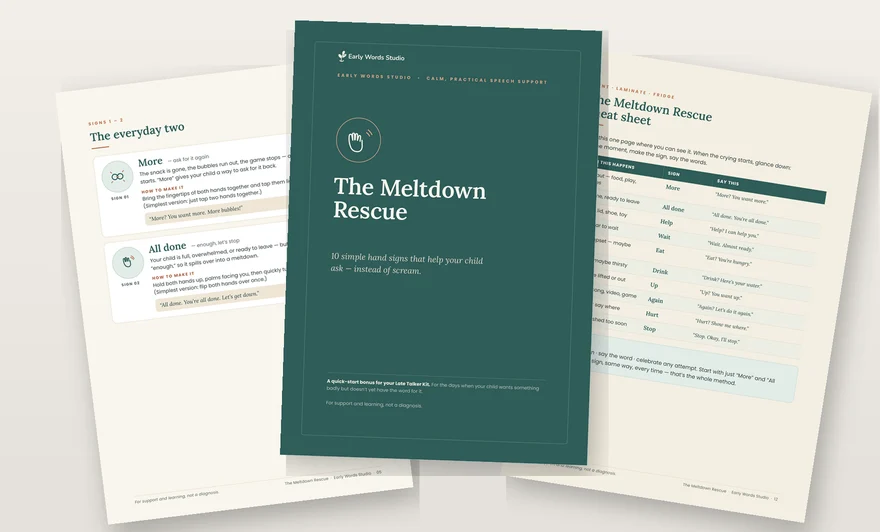
Fast-Action Bonus: The Meltdown Rescue ($17 Value)
The cup is empty. Your child wants more juice, has no word for it yet, and the request comes out as a scream on the kitchen floor.
The Meltdown Rescue gives your child a faster way to ask. It teaches ten simple hand signs for the moments that cause the most everyday frustration: more, all done, help, wait, eat, drink, up, again, hurt, and stop.
Every sign is taught with the same three steps. You make the sign, say the word with it, and respond warmly the moment your child tries. Start with two. “More” and “all done” solve the biggest share of daily meltdowns, and many parents notice calmer moments within a week or two.
Signing will not stop your child from learning to talk. You say the word every time you make the sign, so your child hears it every time. Most children drop a sign once the spoken word arrives.
The guide ends with a one-page cheat sheet. Print it, laminate it, and put it on the fridge, so every caregiver makes the same sign the same way.
The Meltdown Rescue is available exclusively during the founding window. When the initial enrollment cap is reached, this module will be permanently removed from the offer.
Founding price — rises to $67 at 200 families
What this all adds up to:
| Component | Standard Clinical Value |
|---|---|
| Pillar 1: The Communication Snapshot | $17 |
| Pillar 2: The Communication Bridge | $19 |
| Pillar 3: The 15-Minute Play Formula | $21 |
| Pillar 4: The Routine Language Map | $15 |
| Pillar 5: The Script Vault | $13 |
| Pillar 6: The Progress Compass | $12 |
| Bonus 1 — The Red Flags Guide | $27 |
| Bonus 2 — The Caregiver Briefing Pack | $27 |
| Bonus 3 — The First Words Milestone Map | $19 |
| Fast-Action Bonus — The Meltdown Rescue | $17 |
| Total Combined Value | $187 |
You save $140 — that's 75% off the standard value.
Founding Tier Enrollment: $47
(Single payment · No recurring fees)
Immediate digital access · Single one-time payment · 30-day unconditional guarantee
Why only $47
The introductory tier is set at $47 to onboard an initial cohort of 200 families.
In exchange for this subsidized rate, we request direct feedback following your first 30 days, specifically your child's baseline zone, documented Word Wall additions, and observations on routine integration.
This field data directly informs future revisions of the materials.
Enrollment is capped at 200 families so the founding cohort stays small enough for that feedback to shape the first revision. Sending feedback is optional and is not a condition of your purchase or your guarantee.
Once the 200th family registers, the founding cohort will close: the standard price adjusts to $67, and the Meltdown Rescue module will be unbundled from the core system permanently.
By comparison, a single private speech-language session typically ranges from $100 to $200 per clinical hour, frequently accompanied by multi-month waitlists.
The Kit costs less than half of one session, covers every day of the intervening wait period, and remains a permanent home resource.
Because this cohort represents the initial release of the system, this page contains no manufactured testimonials.
The protocols are derived directly from published, peer-reviewed speech-language pathology literature, protected by an unconditional 30-day guarantee.
Empirical documentation on your child's tracking logs serves as the sole measure of efficacy.

30-Day Operational Guarantee
Implement the system in your home for a full 30-day cycle.
Complete the Communication Snapshot, execute the zone-matched interaction protocols within your daily routines, and log your observations in the Progress Portfolio.
If you do not observe measurable communicative progress, or if the framework fails to meet your expectations for any reason, send a single email to receive a prompt, 100% refund.
Zero verification requirements: No mandatory logs to submit, proof-of-work hurdles, or administrative forms.
Immediate processing: Your refund is issued directly to your original payment method.
Retain core screening tools: You keep lifetime access to The Red Flags Guide as a permanent reference guide.
Families navigating speech delays have absorbed months of procedural delay and diagnostic uncertainty.
For your first 30 days of home implementation, the operational risk rests entirely on us.
FAQ
What if the delay indicates a broader developmental condition, such as autism?
The Late Talker Kit is an interaction framework, not a clinical diagnostic instrument.
Nothing in this system replaces or should delay a comprehensive developmental evaluation if indicated.
The Red Flags Guide (Bonus 1) provides objective behavioral criteria to help you distinguish between isolated expressive speech delays and broader developmental patterns that warrant formal evaluation.
Regardless of formal diagnosis, parent-implemented interaction protocols, such as joint attention, calibrated latency, and low-pressure modeling, serve as the foundational communicative baseline.
Maintaining a structured Progress Portfolio ensures that if an evaluation occurs, your clinical team receives dated home observation data rather than subjective impressions.
Does this protocol apply to multilingual households?
Yes. Empirical research confirms that simultaneous or sequential bilingualism does not cause expressive language delays, and parents do not need to eliminate a secondary language.
The Zone-Match assessment evaluates functional communication capacity, including total vocal output, gesture use, and lexical combinations, across all spoken languages.
Apply the interaction protocols in whichever language feels natural for each specific household routine.
A novel communicative attempt or functional word is documented on your tracking log regardless of the language used.
Will these protocols conflict with formal speech therapy or waitlist plans?
No; the framework is designed to integrate directly with clinical speech-language therapy.
While professional clinical sessions typically occur for one hour weekly, environmental language modeling occurs across all remaining daily hours.
The techniques inside the Kit standardize the same evidence-based, parent-implemented strategies utilized by speech-language pathologists.
Sharing your Communication Snapshot and Progress Portfolio with your clinician converts general updates into structured home-practice data.
For families on waitlists, this bridges the observational gap between initial referral and formal intervention.
How do I implement this if other family members or caregivers resist formal routines?
Secondary caregivers do not need to study the full system.
The Caregiver Briefing Pack (Bonus 2) provides single-page reference summaries tailored to your child's specific zone.
Once the primary caregiver completes the 10-minute baseline assessment, secondary caregivers (such as partners, grandparents, or childcare providers) follow the targeted, one-page interaction guidelines to eliminate counterproductive habits like rapid-fire questioning without interpersonal friction.
My child is approaching four years old. Is this system still applicable?
Yes. The Zone-Match Method is calibrated by developmental stage rather than chronological age.
An older toddler presenting at a pre-word or single-word baseline benefits from the exact tier-matched modeling protocols designed for that developmental threshold.
While early childhood neuroplasticity makes prompt intervention advantageous, progress is governed by calibrating techniques to your child's current functional baseline rather than arbitrary calendar deadlines.
Two paths, one more time…
The default approach remains passive observation: accumulating fragmented advice calibrated for general averages, navigating indefinite waitlists, and allowing another month to pass without an operational baseline.
The alternative begins by establishing an objective baseline tonight in ten minutes.
Identify your child's specific communication zone, execute targeted interaction protocols within your existing household routines, and maintain a documented, empirical progress log.
Immediate digital access · Single one-time payment · 30-day unconditional guarantee
Postscripts
P.S.
Pre-verbal toddlers occupy four distinct developmental tiers rather than a uniform delay category; generalized advice fails because it calibrates for aggregate statistical averages rather than your child's functional baseline.
The Zone-Match Method establishes your child's exact baseline in ten minutes and provides targeted interaction protocols designed to embed directly into existing daily routines.
The complete six-pillar toolkit and four supplementary modules ($187 total value) are available for $47 during the 200-family founding cohort, backed by an unconditional 30-day guarantee.
Once enrollment reaches capacity, the standard price adjusts to $67 and the Meltdown Rescue module will be permanently removed.
P.P.S.
This framework is an environmental home intervention system, not a clinical replacement for a formal speech-language evaluation.
The protocols and tracking instruments provide the structure necessary to transform the interim waiting period into an active, data-backed developmental baseline rather than lost observation time.